The Backbone of Commercial Climate Control
When industry leaders think of extruded aluminum, structural architecture is often the first application that comes to mind—curtain walls, framing systems, and high-rise facades. Yet, beyond structural architecture, the 6000 series is the quiet backbone of modern temperature and air control, driving efficiency in commercial and industrial systems where thermal management and airflow regulation are mission-critical.
From my vantage point working alongside North America's leading equipment manufacturers, the pressure on HVAC engineers has never been higher. Tightening federal energy-efficiency mandates, demanding Seasonal Energy Efficiency Ratio (SEER) and Integrated Energy Efficiency Ratio (IEER) targets, and strict building-decarbonization goals are forcing a complete rethink of legacy system design. OEMs are tasked with moving more thermal energy from smaller equipment footprints, reducing electrical draw on fans and compressors, and building rooftop and mechanical room units that withstand decades of harsh environmental exposure without adding structural deadweight.
At the center of this engineering shift are alloy 6063 and the broader 6xxx-series aluminum family. Alloyed primarily with magnesium and silicon to form magnesium silicide, the 6000 series delivers an exceptional balance of high thermal conductivity, natural corrosion resistance, low density, and reliable structural integrity. More importantly, its low flow stress at extrusion temperatures allows it to be formed into complex, multi-void, and ultra-thin-walled profiles with extraordinary dimensional stability.
These specific metallurgical and mechanical properties make the 6000 series the undisputed material of choice for aluminum extrusion HVAC infrastructure, commercial air handling units (AHUs), and high-efficiency heat exchange systems. When your product roadmap depends on maximizing heat transfer while keeping unit weight, assembly labor, and total cost of ownership in check, 6000-series aluminum offers a decisive competitive advantage.
Why Aluminum Outpaces Traditional HVAC Materials
In commercial heating, ventilation, and air conditioning, every material selection ultimately appears on an operational balance sheet. Hospitals, cleanrooms, commercial towers, and industrial manufacturing floors demand continuous, tightly regulated airflow and rapid thermal transfer.
For decades, HVAC engineers weighed the trade-offs between copper, galvanized steel, and aluminum:
The Copper Trade-Off: While copper offers high raw thermal conductivity, it carries a severe weight penalty—roughly three times the density of aluminum—alongside volatile commodity pricing and susceptibility to formicary corrosion in certain condensing environments.
The Steel Trade-Off: Galvanized and stainless steels provide structural rigidity for housings and framing, but their poor thermal conductivity and vulnerability to red rust in high-moisture plenums, condensate pans, and coastal installations create long-term maintenance liabilities.
Aluminum bridges this gap by delivering superior thermal transfer per unit of weight and cost. Specifically, alloy 6063 offers a thermal conductivity of approximately 200 to 218 $\text{W/m}\cdot\text{K}$ (depending on the temper, such as T5 or T6; engineers should verify the exact temper specifications against the primary Aluminum Association standards for specific thermal models). By rapidly absorbing and rejecting thermal energy, aluminum components reduce the workload on compressors and variable-speed fans, directly improving whole-system energy efficiency. Furthermore, shedding hundreds of pounds from commercial rooftop HVAC units (RTUs) simplifies crane rigging, lowers freight costs, and reduces structural load requirements on commercial building roofs.
Heat Exchange Components and Radiator Fin Aluminum
Nowhere is the thermal efficiency of the 6000 series more apparent than in the heat-rejection and absorption core of an HVAC unit. Modern condensers, evaporators, hydronic coils, and fluid-to-air heat exchangers rely heavily on multi-port extruded condenser tubes and precision radiator fin aluminum.
In high-efficiency commercial and residential units, heat exchange depends on maximizing boundary-layer interaction between the refrigerant or glycol loop and the ambient airstream. Through direct precision extrusion, 6000 series alloys are formed into micro-channel and multi-void condenser tubes that withstand high internal operating pressures while presenting a flat, broad contact surface. Paired with densely arrayed radiator-fin aluminum, these assemblies achieve massive surface-area-to-volume ratios in a fraction of the space required by traditional round-tube-and-plate-fin coils.
Furthermore, adopting all-aluminum heat exchanger architectures—pairing 6xxx-series headers and extruded tubes with compatible aluminum fin stock—eliminates the galvanic corrosion that has historically plagued bimetallic copper-to-aluminum coils. Because aluminum naturally forms a protective, passivating oxide layer upon exposure to air, these thin-walled fins and tubes resist constant condensate moisture, industrial pollutants, and coastal salt air, maintaining their thermal transfer coefficient year after year without structural flaking or premature leaks.
Air Handling Equipment: Precision Louvers, Dampers, and Framing
Moving thermal energy at the coil is only half the equation; controlling the volume, velocity, and direction of the air carrying that heat is equally vital. In large-scale commercial ventilation and air handling systems, aluminum extrusion HVAC profiles serve as the primary structural and aerodynamic components.
Consider the engineering demands placed on commercial louvers, dampers, and AHU framing:
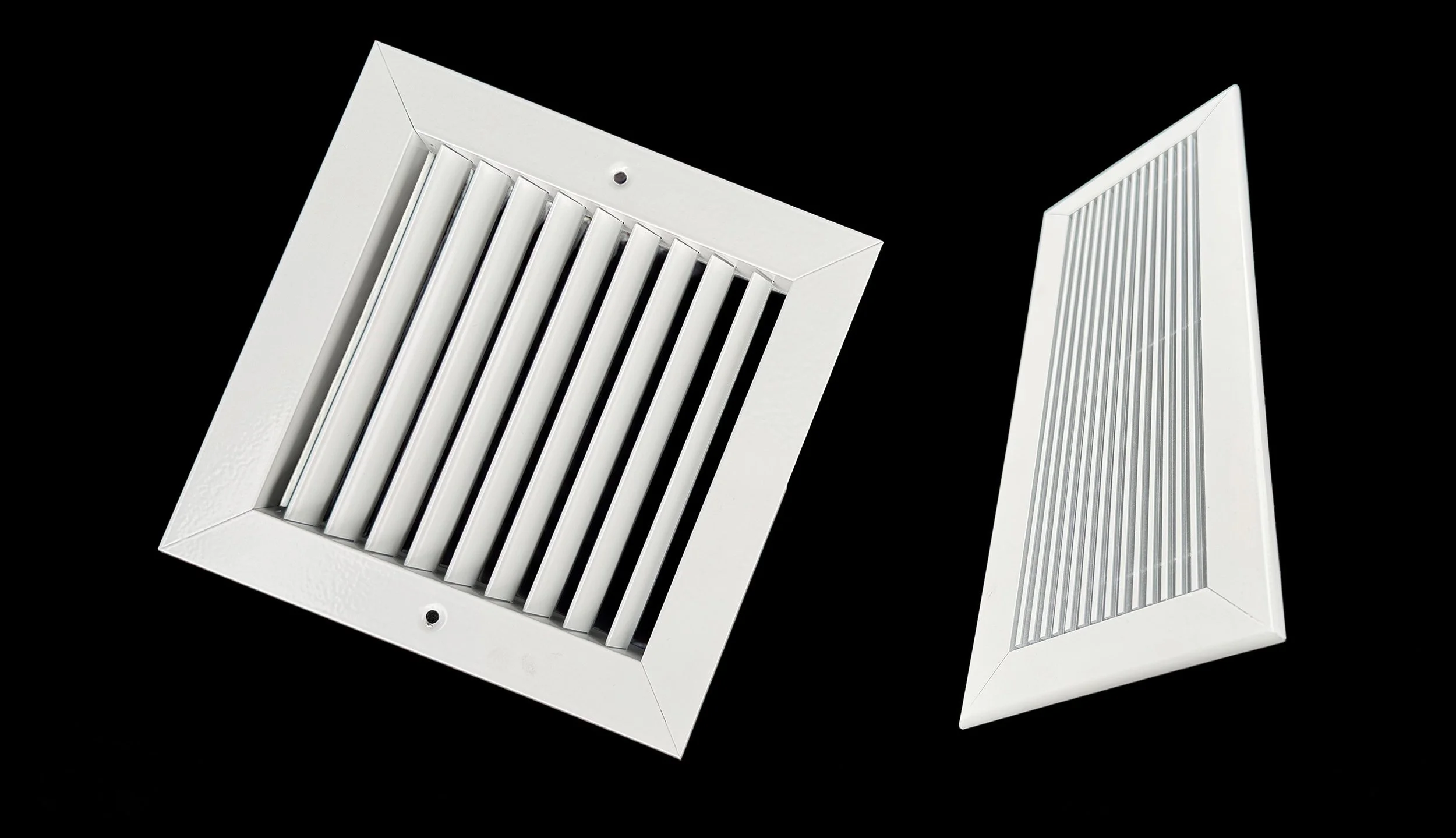
Aerodynamic Airfoil Damper Blades: Extruded damper blades are engineered with hollow or double-skin airfoil cross-sections. Unlike stamped or roll-formed sheet metal, which can flutter, warp, or create turbulent pressure drops under high-velocity airflow, an extruded 6063 airfoil blade maintains rigid torsional stability across wide spans. This minimizes static pressure loss across the air handler, allowing supply and return fans to run at lower RPMs and consume less electricity.
Integrated Interlocks and Seal Channels: Using custom aluminum extrusion applications, engineers design damper blades and perimeter frames with built-in T-slots, axle-pin journals, bulb-seal grooves, and interlocking edges. When a commercial fire, smoke, or low-leakage control damper closes, those precision-extruded tolerances ensure an airtight seal that meets stringent mechanical building codes (such as AMCA leakage ratings).
Weather-Resistant Intake and Exhaust Louvers: Exterior architectural and mechanical louvers must permit high free-area airflow while stripping wind-driven rain and debris from the intake stream. Extruded drainable louver blades incorporate intricate internal gutters and water-catch channels directly into the profile geometry—features that would require expensive multi-step forming or welding in steel.
Thermal Break AHU Framing: Modern air-handling cabinets utilize extruded aluminum pentapost and perimeter framing profiles engineered to accommodate polyamide thermal breaks, preventing condensation ("sweating") on the exterior cabinet skin when handling chilled air in humid mechanical rooms.
The Metra North America Advantage in HVAC Manufacturing
Designing an aerodynamic damper blade or a multi-void condenser profile in CAD is only the first step. For major HVAC OEMs, the commercial challenge lies in securing a manufacturing partner capable of holding tight tolerances across tens of thousands of linear feet without supply chain disruptions.
At Metra North America, we have aligned our operational footprint to remove the friction between complex HVAC engineering and scalable domestic production:
Precision Die & Extrusion Expertise: In aluminum extrusion HVAC assemblies, a fraction of a millimeter of bow, twist, or wall-thickness variation across a 10-foot damper blade or housing rail will cause the assembly to bind in its bearings or leak conditioned air. Our metallurgical and tooling specialists engineer custom dies and strictly control billet temperature, ram speed, and quench rates to hold tight dimensional, flatness, and straightness tolerances.
Domestic Scale for Seasonal Demand: When a commercial HVAC manufacturer is ramping up for peak seasonal production builds, lead-time volatility and overseas port delays are unacceptable. Metra North America delivers the press capacity and domestic footprint required to support high-volume, repeatable production runs across the United States.
End-to-End Vertically Integrated Solutions: Buying raw mill lengths and shipping them to multiple third-party vendors for cutting, punching, and painting erodes margin and inflates work-in-process (WIP) inventory. Metra operates in-house precision cutting, CNC machining, axle-hole punching, corner notching, and specialized surface finishing—including anodizing and high-durability architectural powder and wet coatings that meet rigorous AAMA and coastal corrosion standards. Parts arrive at your facility ready for immediate line assembly.
Building More Efficient Air Systems
From the aerodynamic louvers and low-leakage dampers regulating airflow in modern skyscrapers to the corrosion-resistant radiator fin aluminum and condenser profiles driving heat rejection, 6000 series aluminum is the foundational material powering modern HVAC performance. The unmatched versatility of alloy 6063 and its 6xxx counterparts empowers engineers to reduce system weight, resist corrosion, and achieve higher energy efficiency ratings through custom aluminum extrusion applications.
Realizing that performance at commercial scale requires a partner with the press capacity, metallurgical expertise, and vertically integrated fabrication capabilities to deliver on time, every time. At Metra North America, we build the precision supply chain backbone that keeps your HVAC systems running lighter, longer, and more efficiently.
See Metra's full range of industrial extrusion capabilities.