
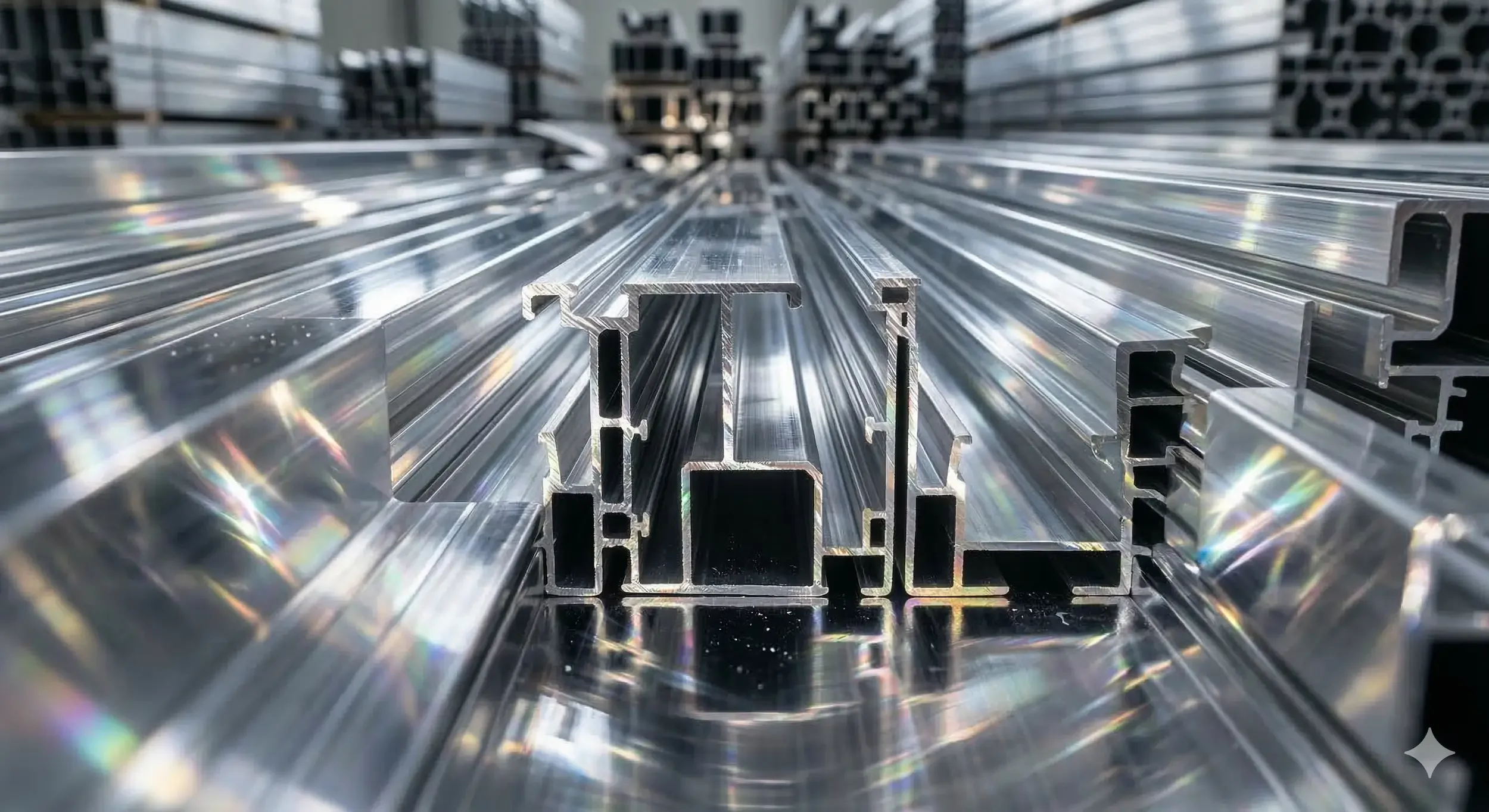
Extruded Aluminum 101
Phases of a vertical production cycle: the transition from raw material to a high-precision, market-ready component
Aluminum Extrusions
The foundation of the process. Creating complex shapes for versatile applications.
-
The Process: Think of it like a "Play-Doh" press for industrial metal. A cylindrical aluminum log (billet) is heated to a starting temperature of ~ 900-1000°F and held at 800-900°F until it is soft but not molten. It is then forced under immense pressure through a steel die to create a continuous profile with a specific cross-sectional shape.
The Materials: The most common alloys are the 6000 series (e.g., 6061, 6063, 6005A), known for their excellent balance of strength, machinability, and corrosion resistance.
-
Strength-to-Weight Ratio: Aluminum is one-third as heavy as steel but can be engineered to be incredibly strong.
Sustainability: Aluminum is infinitely recyclable without losing its properties.
Cost-Efficiency: Extrusion tooling (dies) is relatively inexpensive compared to injection molding or die casting.
-
Industries: Primary users include the Building & Construction sector (windows, curtain walls), Automotive & Transportation (lightweight vehicle components), Industrial Machinery, Solar/Renewable Energy, and Consumer Goods.
Metra North America Connection: Metra North America partners with OEMs and architects who require custom profiles that demand high strength, tight tolerances, and consistent quality across high-volume orders.
-
Design Phase: Extrusion is best selected early in the design process. It allows designers to put metal exactly where it is needed for strength and remove it where it isn’t to save weight.
Complex Geometries: When a component requires complex cross-sections, hollows, or built-in features (like screw bosses, for example) that would be too costly to machine from a solid block.
-
The Facilities: Extrusion takes place on large hydraulic presses, each with a specified tonnage (force).
At Metra North America, we operate a robust network of manufacturing plants across the United States and Canada (including Michigan, Georgia, and Quebec). This geographic spread allows us to serve the entire North American market with reduced shipping times and localized support.
Aluminum Fabrication
Turning raw profiles into ready-to-assemble components.
-
The Services: This encompasses all the mechanical operations performed on the extrusion after it cools. It includes Precision Cutting (to exact lengths), CNC Machining (milling, drilling, tapping), Bending, Deburring, and Assembly.
-
Accountability: Using a single source, such as Metra North America, for both extrusion and fabrication means that one company is responsible for the final part's quality.
Speed: It significantly reduces lead times by removing the step of shipping raw materials to a separate vendor.
-
Manufacturers: Companies that want to simplify their supply chain by receiving "ready-to-install" parts, or near net shapes, rather than raw, long-length bars.
-
Post-Extrusion: Fabrication occurs after the aluminum has been extruded, cooled, stretched, and heat-treated (aged) to its final hardness.
-
The "One-Stop" Shop: Ideally, fabrication happens under the same roof as extrusion to minimize handling and freight costs. We control the process from A to Z and that we have the quality infrastructure in place to cover all operations.
At Metra North America, we provide robust in-house fabrication, integrating extrusion and machining to streamline your supply chain. By managing the production cycle vertically, we significantly reduce reliance on outside vendors, lowering the risk of damage and ensuring a precision fit for every part.
Aluminum Finishing
Adding aesthetics, durability, and protection.
-
Painting (Liquid & Powder Coat): Applying colored coatings for aesthetic appeal and environmental protection. High-performance liquid paints (like PVDF) are standard for architectural projects.
Anodizing: An electrochemical process that thickens the natural oxide layer on the aluminum, creating a finish that is integral to the metal itself—it cannot peel or chip.
-
Protection: While aluminum naturally resists corrosion, finishing provides a shield against harsh environments (salt spray, UV rays, pollution).
Aesthetics: It allows brands to match their corporate colors or achieve specific architectural looks (e.g., matte, gloss, metallic).
Durability: Finishes such as anodizing create a surface harder than the raw aluminum, increasing resistance to wear and abrasion.
-
Architects & Designers: Professionals looking for long-lasting color retention and weather resistance for building facades.
Engineers: Those requiring enhanced surface hardness or electrical insulation.
-
The Final Step: Finishing is typically the last manufacturing step before packaging and shipping.
-
The Finishing Line: Finishing is applied in specialized, dust-free environments, while using application-certified equipment.
At Metra North America, we offer advanced finishing capabilities, including painting and anodizing services. Whether you need a custom color match or a standard clear anodize, our facilities ensure the finish meets rigorous industry standards (such as AAMA specifications).