6061 vs. 6063 vs. 6005: Choosing the Right 6000 Series Alloy for Your Extrusion Project
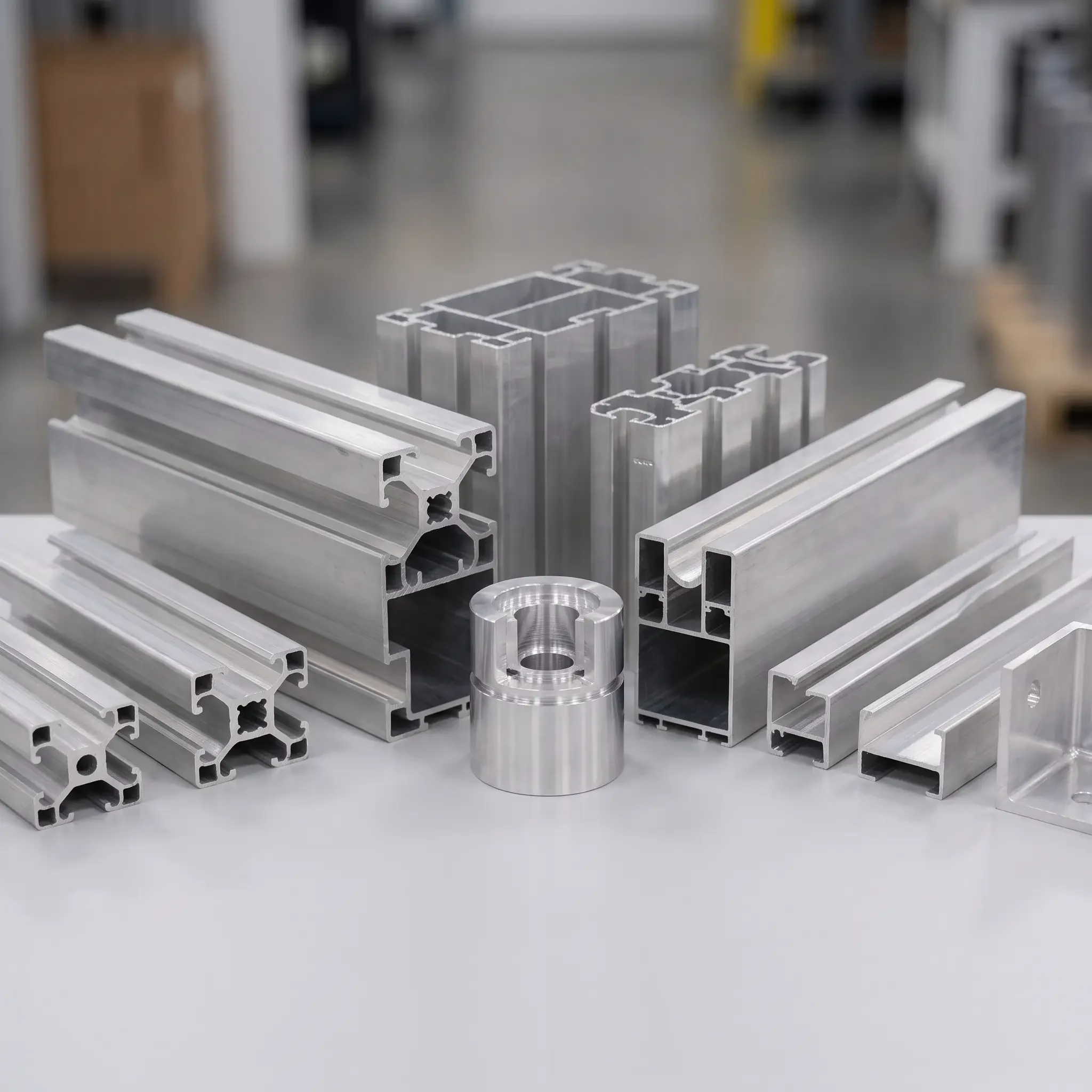
Material specification at the CAD stage makes or breaks project budgets, structural integrity, and manufacturing lead times. The Al-Mg-Si (magnesium-silicide) 6000-series alloys are the undisputed standard for modern extrusion, but they present an engineering dilemma: balancing structural performance against profile complexity, surface cosmetic requirements, and extrusion press speed. Metra North America’s multi-alloy capabilities and early design-assist engineering philosophy span our entire manufacturing footprint to help you navigate these choices.
The Core Alloy Profiles & Trade-Offs
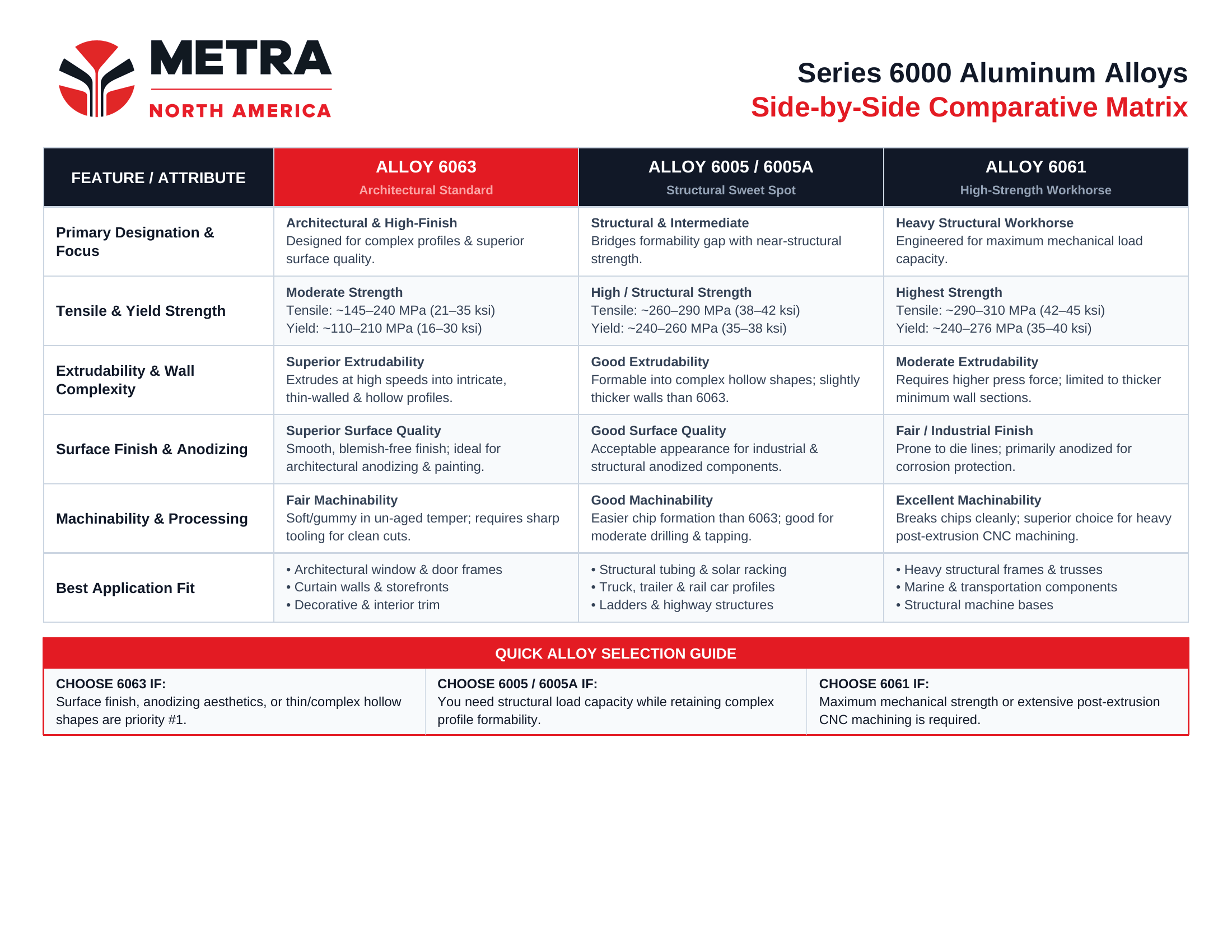
Alloy 6063 (The Architectural & Formability Standard): Offers outstanding extrudability, sharp profile detail, tight dimensional tolerances, and superior anodizing/paint response. With moderate yield and tensile strength, it is ideal for fenestration, curtain walls, lighting tracks, and decorative trims. However, it is not suited for heavy cyclic fatigue or primary load-bearing structural frames.
Alloy 6061 (The High-Strength Structural Workhorse): Delivers excellent tensile and yield strength (~35 ksi yield in -T6, ~42 ksi ultimate, 13% elongation), solid weldability, robust corrosion resistance, and crisp machinability. It is best suited for heavy transportation, marine frames, and machinery brackets, though it suffers from lower extrudability, challenges with intricate hollows, and a rougher surface finish.
Alloy 6005 / 6005A (The "Sweet Spot"): Bridges the gap by delivering near-6061 strength (~35 ksi yield in -T6, ~41 ksi ultimate, 11% elongation) while retaining superior extrudability. It offers higher fracture toughness in complex hollow geometries and is suitable for solar racking, transit profiles, and structural tubing. 6005A has a slight cost advantage over 6061, while 6063 has a significant cost advantage over 6061.
Side-by-Side Comparative Matrix
Heat Treatment, Tempering, & Quench Sensitivity
Precipitation hardening through solution heat treatment, quenching, and artificial aging dictates an alloy's final mechanical properties.
T4: Solution heat-treated and naturally aged, making it optimal for post-extrusion bending and cold forming.
T5: Cooled from an elevated temperature shaping process and artificially aged, commonly used for 6063 architectural lines.
T6 & T61: Solution heat-treated and artificially aged to maximum mechanical strength, which is essential for structural 6061 and 6005 profiles.
Quench Sensitivity: 6063 can be air-quenched at the press runout table, whereas 6061 often requires aggressive water quenching, which can introduce profile distortion without proper controls. Metra actively adjusts quench sprays to control dimensions and monitors multi-zone oven temperatures to produce consistent results.
Design-Stage Decision Framework
Define the Primary Driver: Choose 6063 for aesthetics/finish, 6061 for heavy structural loading/machining, and 6005/6005A for structural loads combined with intricate hollows or thin webs.
Evaluate Total Cost of Ownership (TCO): Avoid over-specifying. Specifying 6061 when 6005 or 6063 suffices drives up extrusion press cycle times, accelerates die wear, and increases unit weight and overall cost.
Factor Secondary Operations: Account for joining methods, welding strength knockdown, bending radii, and assembly tolerances during the alloy selection process.
Why Partner with Metra North America?
Design-Assist Services: One of our strengths is how much less our tooling costs compared to other materials. We collaborate during initial CAD development to optimize wall thicknesses, corner radii, and alloy selection, thereby enabling die optimization and lowering production costs.
Multi-Alloy Press Capability: We seamlessly run 6063, 6005/6005A, and 6061 to align with diverse industry demands.
Strategic Domestic Footprint: Five North American facilities (including locations such as Belding and Rome) ensure localized logistics, supply chain resilience, press-size and capacity redundancy, and shorter lead times.
Turnkey Finishing & Fabrication: We provide in-house anodizing, powder coating, precision cutting, and CNC machining calibrated to each alloy's specific metallurgy.
| Press Capabilities | ||
|---|---|---|
| Location | Press Size | Tonnage |
| Belding, MI | 7" | 1,800 |
| Belding, MI | 9" | 2,400 |
| Belding, MI | 10" | 3,000 |
| Belding, MI | 12" | 4,500 |
| Belding, MI (2023) |
14" | 6,300 |
| Rome, GA | 7" | 2,000 |
| Rome, GA (2023) |
7" | 2,280 |
| Rome, GA | 8" | 2,750 |
| Laval, QC - Canada | 7" | 1,650 |
| Laval, QC - Canada | 9" | 2,800 |
| Alma, QC - Canada | 9" | 3,000 |
| ADDITIONAL FACILITIES | ||
| Kentwood, MI | Fabrication and Assembly | |
| Indianapolis, IN | Anodize and Paint | |
Take the Guesswork Out of Alloy Selection: Choosing among 6061, 6063, and 6005 shouldn't require costly trial and error. Early collaboration with an extrusion specialist optimizes both product performance and production economics.
Talk to a Metra engineer about your alloy selection today to request a Technical Design Review.